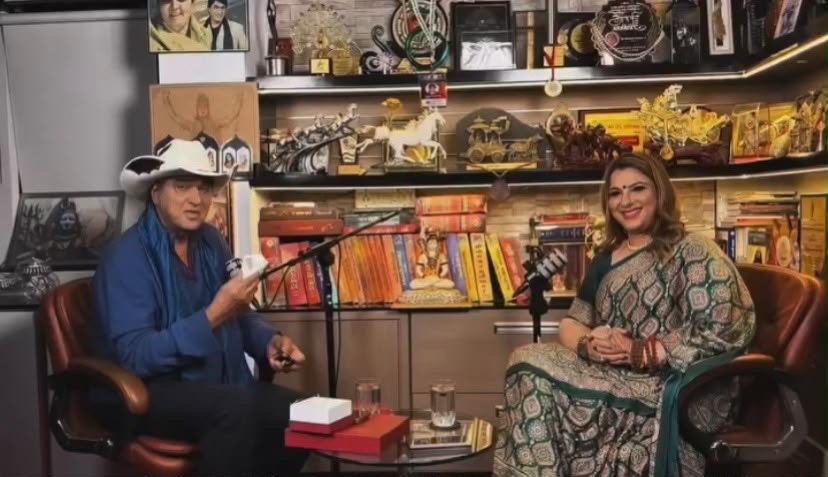
Mumbai: Astrologer and psychic Geetu Parmar recently sat down with actor Mukesh Khanna for a conversation that moved from Shaktimaan to spirituality, from the state of Indian television to the state of the Indian soul. Mukesh, who has carried two of Indian television’s most iconic identities for decades, didn’t hold back.
Geetu asked him whether today’s heroes are able to teach children anything. Mukesh said, “Whatever I have achieved, Shaktimaan came in 1997. I think Mahabharat came in 1989. My two images have run together.”

He recalled a different era of public life. Mukesh said, “During Atal Bihari Vajpayee ji’s time, I campaigned across the entire country. There would be announcements on the microphone, Bhishma Pitamah for the elders, Shaktimaan for the children. The elders would come from one side, the children from the other. They didn’t even have the right to vote. They would simply come and cheer.”
But the children of today concern him deeply. Mukesh said, “Today’s children are running, they are lost, they are running so fast. They don’t even know why they are running. A child today sees everyone running, so he also starts running. He keeps running and running, and when everyone finally stops at one place, he looks around and finds there is nothing there. Then he asks his friend, why were you running? The friend replies, I don’t know. Everyone else was running, so I ran too.”
The fix, for him, is rooted in something older than social media. Mukesh said, “If our country has to become a Vishwaguru tomorrow, Modi ji says our country will become the youngest nation in twenty-five years. But I ask one question. After twenty-five years, when that young generation reaches that point, will their shoulders be strong? Or will they be shaking? Because if they shake, the country will shake too.”
He shared that he has watched multiple versions of Mahabharat come and go after the original 1989 series. None of them, in his view, came close. He credited the original team before himself. Mukesh said, “I will not praise myself. But I will praise Dr. Rahi Masoom Raza, who gave me such powerful dialogues. I will praise Pandit Narendra Sharma, and I will also praise Mahabharat itself, because there can never be another character like Bhishma Pitamah.”

The later versions lacked the foundation. Mukesh said, “They didn’t have Dr. Rahi Masoom Raza. They didn’t have Pandit Narendra Sharma. They didn’t have B. R. Chopra’s storytelling. They turned the Pandavas into modern-day characters. Today, no one would even know who played Nakul, who played Bhima, or who played Arjuna.”
He recalled how rigorously the original cast was chosen. Mukesh said, “At that time, I had already been the hero of fifteen films. My films flopped, so I was sitting at home without work. I gave a proper audition, even wearing the complete get-up despite having a sprain. Today, what happens? Someone simply says, you become Sita, you become Draupadi, you become Bhishma. It doesn’t work that way.”
The liberties taken with the source material disturbed him most. Mukesh said, “Vyasa Muni’s Mahabharat was changed. Satyavati was made into a vamp. She was shown saying to Bhishma, your son will become the king, and my son will become a beggar. She never said that. Everything had been changed. Whether it was Ekta Kapoor’s version or the ones that came later, there was no soul in them.”
He was direct about the line that shouldn’t be crossed. “You cannot change your country’s traditions. You cannot change the Vedas and the heritage of this nation, Mukesh ended.












 https://www.youtube.com/watch?si=RtToJsBhYBatUrym&v=mOuYNSdhjHA&feature=youtu.be